
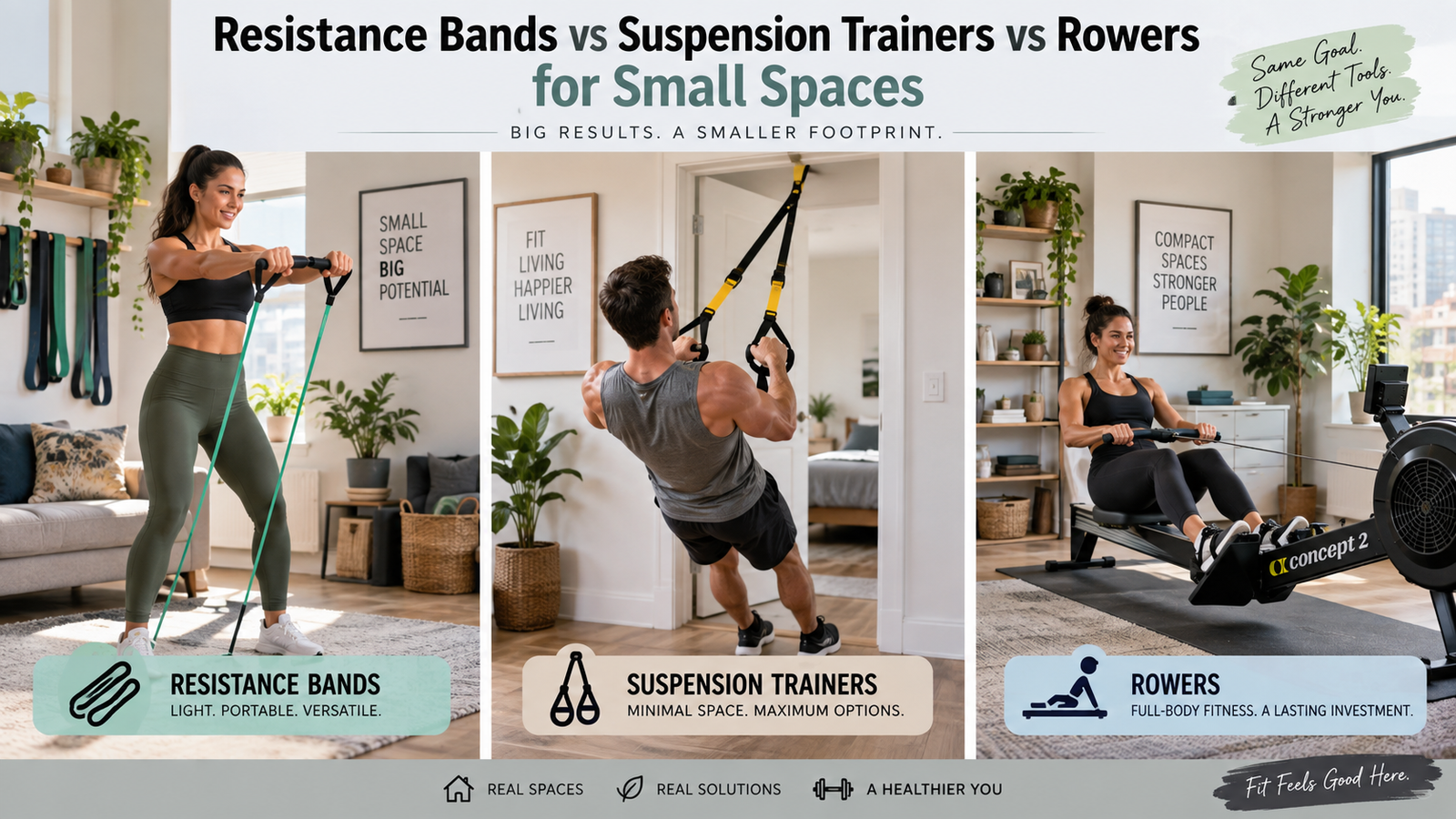
Choosing home exercise equipment becomes more complicated when you live in a small apartment. A machine might look compact in a product photo but require considerable room during use. Likewise, a lightweight suspension trainer may fit inside a drawer but need a secure anchor and enough space for movement. .
When comparing resistance bands vs. suspension trainers vs. rowers for small spaces, you need to consider more than storage dimensions.
Your exercise goals, available floor area, noise tolerance, budget, and ability to set up the equipment safely all matter.
This guide compares the three options and explains how to choose equipment that fits your home and workout needs.
Table of Contents
1. Resistance Bands vs Suspension Trainers vs Rowers for Small Spaces
Choosing home exercise equipment becomes more complicated when you live in a small apartment. A machine might look compact in a product photo but require considerable room during use. Likewise, a lightweight suspension trainer may fit inside a drawer but need a secure anchor and enough space for movement.
When comparing resistance bands vs. suspension trainers vs. rowers for small spaces, you need to consider more than storage dimensions.
Your exercise goals, available floor area, noise tolerance, budget, and ability to set up the equipment safely all matter.
This guide compares the three options and explains how to choose equipment that fits your home and workout needs.
1. Resistance Bands: Compact Equipment for Strength Training

Resistance bands are elastic exercise tools that provide resistance when stretched. They come in several styles, including flat bands, loop bands, and tubes with handles.
They are lightweight, portable, and easy to store, making them practical for apartments with limited storage.
According to the American Council on Exercise, resistance bands offer a versatile and effective way to perform strength training, provided they are used correctly.
Resistance band safety:
American Council on Exercise
acefitness.org
Advantages of resistance bands
- They can fit in a drawer, bag, or small storage basket.
- They require no large exercise machine.
- Different resistance levels allow you to adjust the challenge.
- They can be used for upper- and lower-body exercises.
- Many movements can be performed without permanently installing an anchor.
For someone working out in a bedroom or shared apartment, resistance bands offer considerable flexibility.
Limitations
Bands do not provide the same resistance throughout every movement. As the elastic material stretches, resistance generally increases.
Some exercises also require an appropriate anchor point.
Bands can snap if they are damaged, overstretched, or used incorrectly.
Inspect them before exercising and replace bands with visible cuts, cracks, or other damage.
Who might choose resistance bands?
Consider resistance bands if you want an affordable, portable strength-training option and do not have room for large equipment.
They are also useful if you regularly move between rooms or need to pack your equipment away after every session.
2. Suspension Trainers: Bodyweight Training With an Anchor

Suspension trainers use adjustable straps attached to a secure anchor point.
Instead of lifting external weights, you use your body weight as resistance.
You can change the difficulty of many exercises by adjusting your body position.
Typical exercises include suspension rows, assisted squats, standing chest presses, and certain core movements.
Advantages of suspension trainers
Suspension trainers can support exercises for the upper body, lower body, and core.
The straps themselves occupy very little storage space. They can be packed away when the workout is finished.
Their main advantage is adjustable bodyweight resistance without requiring several separate weight machines.
How much space do they need?
The important limitation is movement clearance.
TRX recommends trying to find a workout area approximately 8 feet long and 6 feet wide for its suspension training system. Actual requirements depend on the exercise and model.
A suspension trainer may therefore be compact in storage without being suitable for every tiny room.
Safety considerations
A suitable anchor is essential.
Before using a suspension trainer:
- Follow the manufacturer’s installation instructions.
- Use an approved, secure anchor point.
- Make sure the door and frame are appropriate if using a door anchor.
- Test the connection before putting your full body weight on the straps.
- Keep sufficient clearance around your body.
TRX advises against using unsuitable doors, including glass, sliding, lightweight, or damaged doors, with its door-anchor setup.
American College of Sports Medicine
Do not attach suspension straps to an ordinary curtain rod, loose fixture, or unverified ceiling attachment.
Who might choose a suspension trainer?
A suspension trainer may suit someone who wants varied bodyweight strength exercises, has a suitable anchor, and can leave enough clear floor space during workouts.
It is less practical when there is no safe mounting option.
3. Rowing Machines: Cardio Equipment With a Larger Footprint

Indoor rowing machines simulate the rowing movement using a sliding seat, foot supports, and resistance mechanism.
Resistance systems differ between models and may include air, water, magnetic, or other designs.
Rowing involves the legs, trunk, and upper body while providing an aerobic workout.
Harvard Health identifies rowing machines as an option for full-body exercise, although individual suitability depends on health, fitness, and technique.
Advantages of rowing machines
- They support sustained aerobic exercise.
- They allow you to vary workout intensity.
- Many models provide performance measurements.
- They are an indoor option when outdoor exercise is inconvenient.
However, the movement alone should not be treated as a complete replacement for dedicated muscle-strengthening exercises.
The space problem
A rowing machine may occupy significantly more room than its product photograph suggests.
For example, the standard Concept2 RowErg has the following manufacturer specifications:
CONCEPT2 ROW ERG — EXAMPLE DIMENSIONS
Machine length
244 cm
96 inches
Machine width
61 cm
24 inches
Recommended space during use
274 × 122 cm
Approximately 9 × 4 feet
Example specifications from Concept2. Other rowers may differ.
The Concept2 model can be separated into two pieces for storage, but that does not eliminate its operating-space requirement.
Before purchasing a rowing machine, measure the actual area available when you intend to use it.
Noise considerations
Not all rowing machines produce the same sound.
Air-resistance models generate flywheel noise. Other resistance systems have different sound characteristics, and floor vibration may still be an issue.
Concept2 notes that its flywheel produces airflow noise, which varies with workout intensity.
Do not assume that a machine described as quiet will be inaudible to neighbors.
Who might choose a rower?
A rowing machine may suit someone who prioritizes structured indoor cardio, has sufficient operating space, and is comfortable with the equipment’s cost and storage requirements.
4. Resistance Bands vs Suspension Trainers vs Rowers: Side-by-Side Comparison
Space and functionality comparison
| Feature | Resistance bands | Suspension trainers | Rowing machines |
| Primary use | Strength exercises | Bodyweight strength | Mainly aerobic training |
| Storage | Very compact | Very compact | Model-dependent; often bulky |
| Setup | Usually simple | Secure anchor required | Floor setup required |
| Movement space | Depends on exercise | Clear space around anchor | Long, clear floor area |
| Noise | Usually low | Usually low with controlled movements | Varies by model |
| Portability | High | High | Limited |
| Typical cost | Generally lower | Varies by system | Generally higher |
General comparison based on equipment design. Exact dimensions, features and prices vary by product.
The table highlights an important distinction: storage size and workout space are not the same thing.
Resistance bands and suspension trainers may fit inside a drawer, but you still need enough room to perform movements safely.
A rower needs a longer unobstructed area and a suitable storage location.
5. Which Equipment Fits Your Exercise Goals?
Before purchasing any equipment, identify what you want your workouts to accomplish.
For building strength
Resistance bands and suspension trainers both provide options for resistance training.
The American College of Sports Medicine’s updated 2026 guidance recognizes elastic bands, bodyweight exercises, and home-based training as effective methods for improving strength and physical function.
You do not need a complicated home gym to begin strengthening your muscles.
For cardiovascular fitness
A rowing machine provides an option for sustained aerobic exercise.
However, you can also build aerobic fitness through brisk walking, cycling, or suitable low-impact workouts without purchasing a large machine.
For ideas about developing a consistent aerobic routine, read our daily walking routine for healthy weight management.
For a balanced routine
Rather than expecting one device to meet every fitness need, plan for both aerobic activity and muscle strengthening.
The CDC recommends that adults accumulate at least 150 minutes of moderate-intensity aerobic activity per week and perform muscle-strengthening activities on two or more days.
Your exact routine should reflect your health, fitness level, and abilities.
6. What Should You Check Before Buying?

Avoid purchasing equipment based only on the dimensions shown in a product listing.
Use this checklist first.
Pre-purchase checklist
0/7 Measure the clear floor area, not the entire room. Check operating dimensions and movement clearance. Decide where the equipment will be stored. Consider noise and vibration if you share a building. Verify installation requirements and anchor compatibility. Check product weight, user limits, warranty, and maintenance. Choose equipment that matches the workouts you will actually perform. Reset checklist
A practical example
Imagine a bedroom with an available exercise area measuring 6 feet long and 4 feet wide.
A full-size Concept2 RowErg would not fit within its manufacturer’s recommended 9 × 4-foot operating area.
A suspension trainer may also need more length or width, depending on the movements.
Resistance bands could accommodate selected standing exercises, provided there is sufficient clearance.
This illustrates why checking measurements before buying is more useful than relying on the term “compact.”
7. Equipment Safety and Common Mistakes
Each equipment type introduces different risks.
Resistance bands: Inspect the elastic material, handles, and anchor connections. Never release a stretched band suddenly.
Suspension trainers: Use a manufacturer-approved anchoring method and confirm the anchor is secure before starting. Do not use damaged straps.
Rowing machines: Learn the correct rowing sequence before attempting fast or demanding intervals.
Concept2’s technique instructions explain that the rowing drive begins with the legs, followed by the body and then the arms. The recovery reverses that sequence.
For any equipment, begin with manageable effort and progress gradually.
People with cardiovascular conditions, recent injuries, significant joint pain, or other relevant medical concerns should seek individualized advice before beginning an unfamiliar exercise program.
Stop exercising if you experience chest pain, faintness, or unusual shortness of breath.
8. Can You Combine Different Types of Equipment?
Yes. Different equipment can serve different purposes.
For example, someone with enough space might use resistance bands for strength exercises and a rowing machine for aerobic sessions.
Another person may combine suspension training with outdoor walking.
However, owning multiple devices is not necessary.
Start with an exercise routine you can maintain. Add equipment only when it serves a clear purpose.
Buying three products without a realistic plan may create clutter rather than improve consistency.
Frequently Asked Questions
Are resistance bands effective for building muscle?
Yes. Resistance bands can support improvements in strength and muscle development when exercises provide an appropriate challenge and are performed consistently. Progressive resistance and a balanced training program remain important.
Can a suspension trainer fit in a small bedroom?
Possibly, but it depends on the available exercise space and the anchor. Measure the room and consult the manufacturer’s clearance and installation instructions before purchasing.
Is a rowing machine suitable for an apartment?
It can be, provided there is enough operating space, a suitable storage location, and acceptable noise conditions.
Measure the exact machine rather than assuming all compact rowers share the same dimensions.
Do resistance bands replace cardio exercise?
Ordinary resistance-band strength sessions should not automatically be counted as moderate-intensity aerobic activity.
A routine can include resistance training alongside walking, cycling, rowing, or other aerobic activities.
Do I need all three types of equipment?
No. Choose equipment according to your available space, exercise goals, and budget. You can also begin with bodyweight workouts that require no equipment.
Conclusion
Resistance bands, suspension trainers, and rowing machines offer different ways to exercise at home.
Resistance bands are highly portable and practical for many strength exercises. Suspension trainers provide adjustable bodyweight resistance but require a secure anchor and suitable movement space. Rowing machines offer structured aerobic training but generally need more room during use.
The right purchase depends on accurate measurements, safety requirements, exercise goals, and how consistently you expect to use the equipment.
A smaller amount of suitable equipment is often more practical than filling an apartment with machines you rarely use.
How to Build a Daily Walking Routine for Healthy Weight Management