
Choosing an Apartment Workout Machine is different from buying equipment for a garage or a large home gym. In an apartment, you have to think about more than exercise options. Space, noise, stability, floor protection, adjustability, and total cost can all affect whether the machine actually works for your home.
A machine may advertise dozens of exercises, but that does not automatically make it a useful purchase. The better approach is to look at how well the equipment fits your available space, your workout goals, and the exercises you actually plan to perform.
This guide explains what to check before spending your money.
Table of Contents
1. Start With the Space You Actually Have
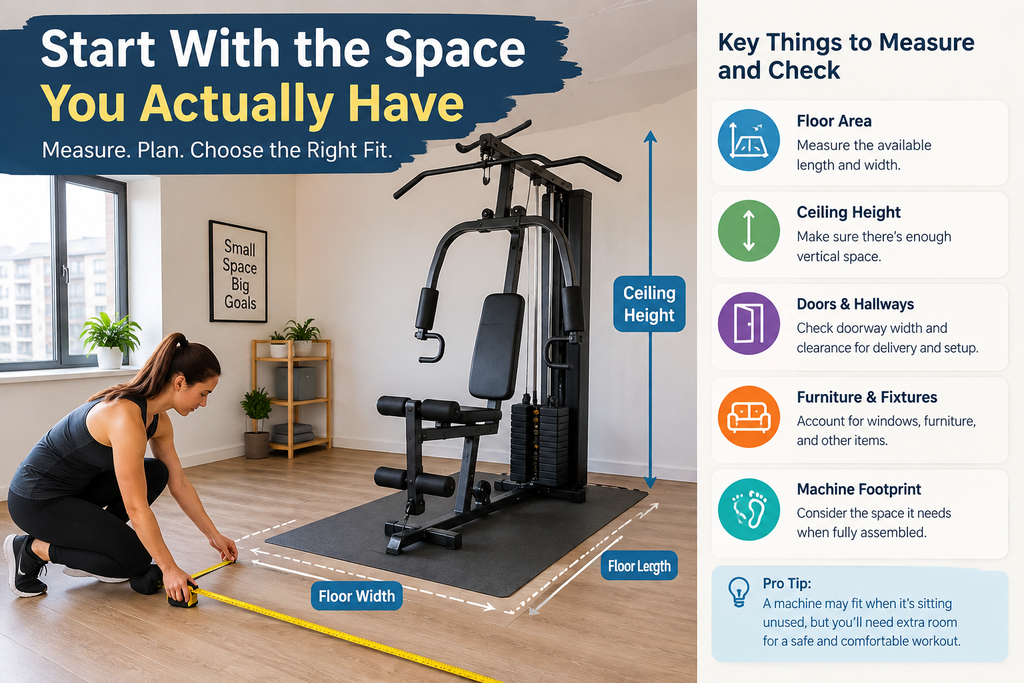
Space is one of the biggest limitations when choosing an Apartment Workout Machine.
Before looking at features, measure the area where you plan to place the equipment.
Check:
- Available floor length
- Available floor width
- Ceiling height
- Doorway width
- Distance from walls and furniture
- Space needed to move around the machine
Do not look only at the machine’s listed footprint. A machine may fit when it is sitting unused but require considerably more room during a workout.
For example, a bench may need to extend, cable arms may move outward, or handles may require additional clearance.
Don’t Forget Storage
Think about where you will keep:
- Weight plates
- Handles
- Resistance bands
- Attachments
- Benches
- Other accessories
The machine needs to fit your apartment and leave enough room for safe use.
CDC: Physical activity guidelines
2. Check the Exercise Coverage Instead of the Exercise Count
Many manufacturers advertise machines with claims such as “50+ exercises” or “100+ exercises.” A large number can sound impressive, but exercise count alone does not tell you how useful the machine will be.
Some advertised exercises may simply be minor variations of the same movement.
Instead, check whether the machine supports the movement patterns and exercises you actually need.
Consider:
- Push
- Pull
- Squat
- Hinge
- Core
- Upper-body isolation
- Lower-body exercises
For example, if your routine includes squats, rows, chest presses, lat pulldowns, curls, triceps exercises, and core movements, check whether the machine performs those exercises comfortably.
Best Full-Body Workout Machines for Small Spaces
Useful exercise coverage matters more than a large marketing number.
3. Check the Resistance Range and Progression
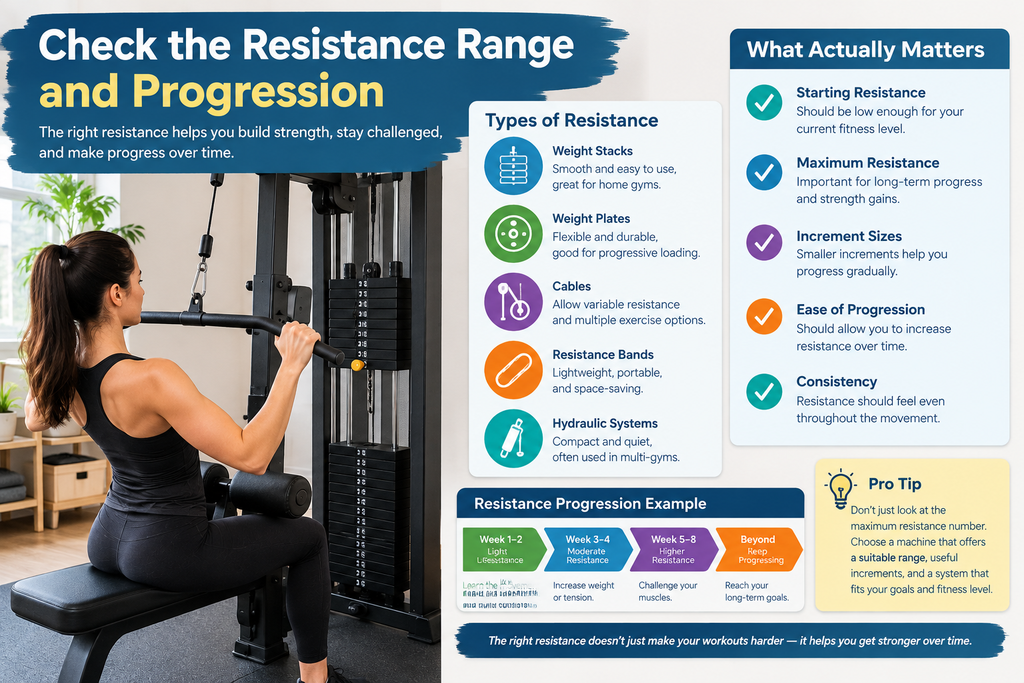
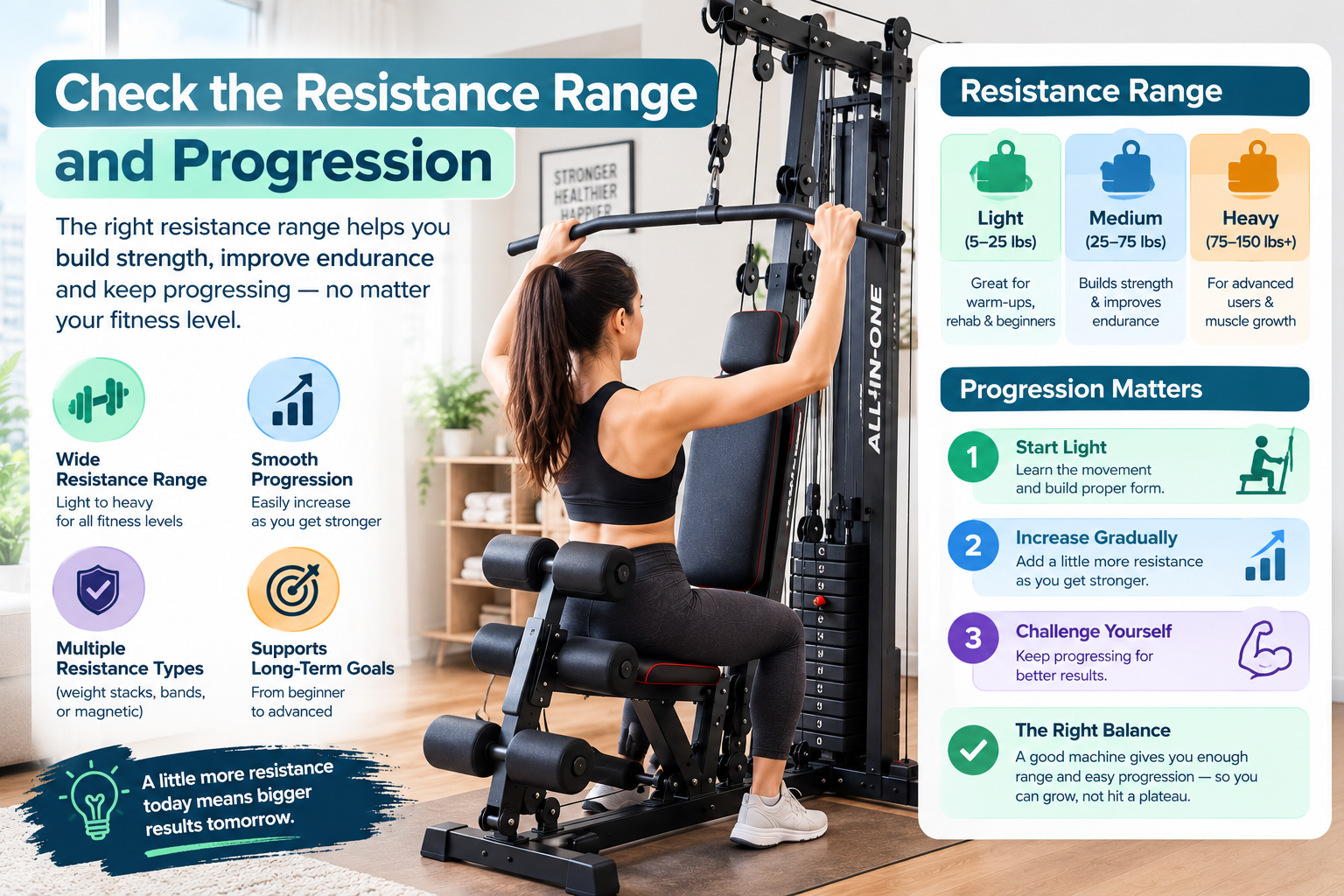
Resistance is another important factor.
Do not look only at the maximum resistance listed on the product page. Check the complete resistance range.
Starting Resistance
A machine that starts with resistance that is too high may not suit some exercises or beginners.
Maximum Resistance
Maximum resistance becomes more important if you expect your strength to increase over time.
However, the highest number is not automatically the most useful specification.
Resistance Increments
Look at how resistance increases.
Smaller, manageable increases can make it easier to progress gradually instead of being forced into large jumps.
Ask yourself:
Can I increase the resistance gradually as my strength improves?
Also consider the resistance system, such as:
- Weight stacks
- Weight plates
- Cable systems
- Resistance bands
- Other resistance mechanisms
The goal is not simply to find the machine with the biggest resistance number. It is to find a system that provides resistance appropriate for your current ability and future progression.
8 Space-Saving Workout Habits for Apartments and Small Rooms
4. Make Sure the Machine Fits Your Body
An Apartment Workout Machine can have good specifications and still be uncomfortable if it does not adjust properly to your body.
Before buying, check:
- Seat height
- Bench adjustment
- Backrest positions
- Cable height
- Handle positions
- Grip options
- Maximum user height
- Maximum user weight
Do not assume that the word “adjustable” means the machine will fit everyone.
Look for the actual adjustment range whenever the manufacturer provides it.
A machine should allow you to set up the equipment comfortably for the exercises you intend to perform.
5. Think About Noise Before Buying
Noise deserves extra attention in an apartment.
Possible sources of noise include:
- Weight stacks
- Metal components
- Cables and pulleys
- Moving benches
- Plates being placed down
- Vibrations through the floor
Even when a machine itself does not seem extremely loud, movement and vibration can travel through floors and walls.
Before buying, consider:
- Does the equipment allow controlled movement?
- Do weights make significant contact when lowered?
- Does the frame move during exercise?
- Could a suitable rubber mat help protect the floor and reduce some vibration?
- Are there moving parts that may create noticeable noise?
Avoid assuming that any machine will be completely silent. Instead, look for equipment designed for stable and controlled movement.
ACSM: resistance training guidance
6. Check Stability and Build Quality
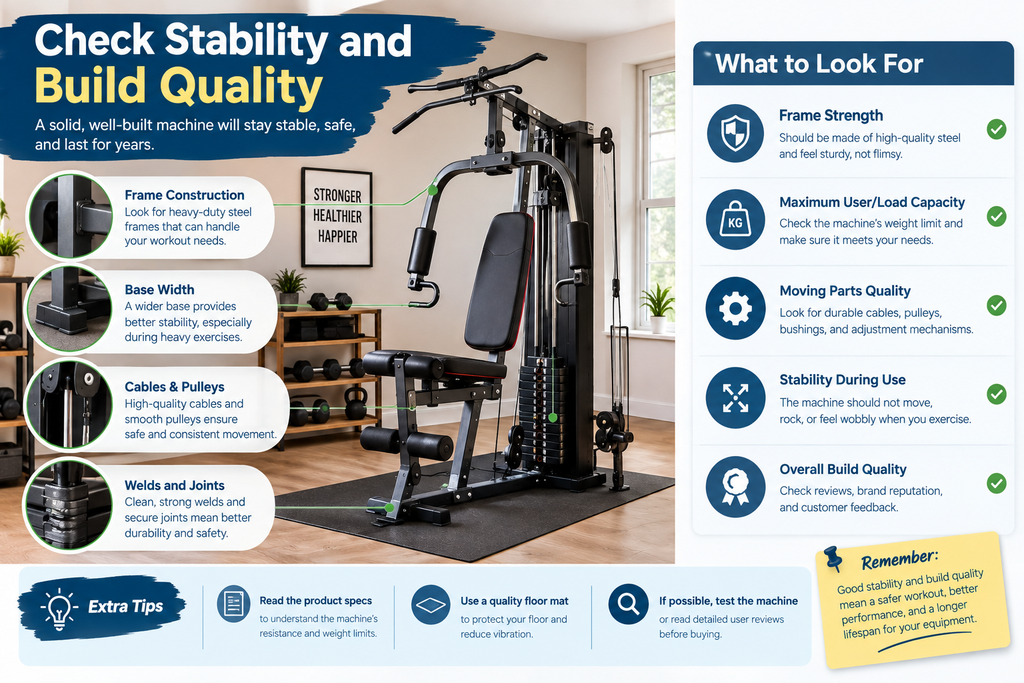
A compact machine still needs to remain stable during exercise.
Look at the construction of the:
Frame
Check whether the frame is appropriate for the intended loads and exercises.
Base
Pay attention to the base design and how the equipment sits on the floor.
Moving Parts
Inspect the available information about:
- Cables
- Pulleys
- Joints
- Adjustment mechanisms
- Bearings and other moving components
Also check the machine’s specifications carefully.
Do not confuse maximum user weight with resistance capacity. They describe different things.
Maximum user weight relates to the person using the equipment, while resistance capacity relates to the load or resistance system.
7. Consider Safety Features
Don’t overlook safety simply because the equipment is compact.
Look for features such as:
- Locking mechanisms
- Safety catches where applicable
- Protected moving parts
- Secure cable routing
- Weight-stack guards
- Stable attachments
- Clear operating instructions
Leave enough space around moving components.
A machine that technically fits into a small corner may not be practical if you cannot safely perform the exercises.
Always follow the manufacturer’s assembly and operating instructions, and use the equipment as intended.
8. Don’t Forget Your Apartment Floor
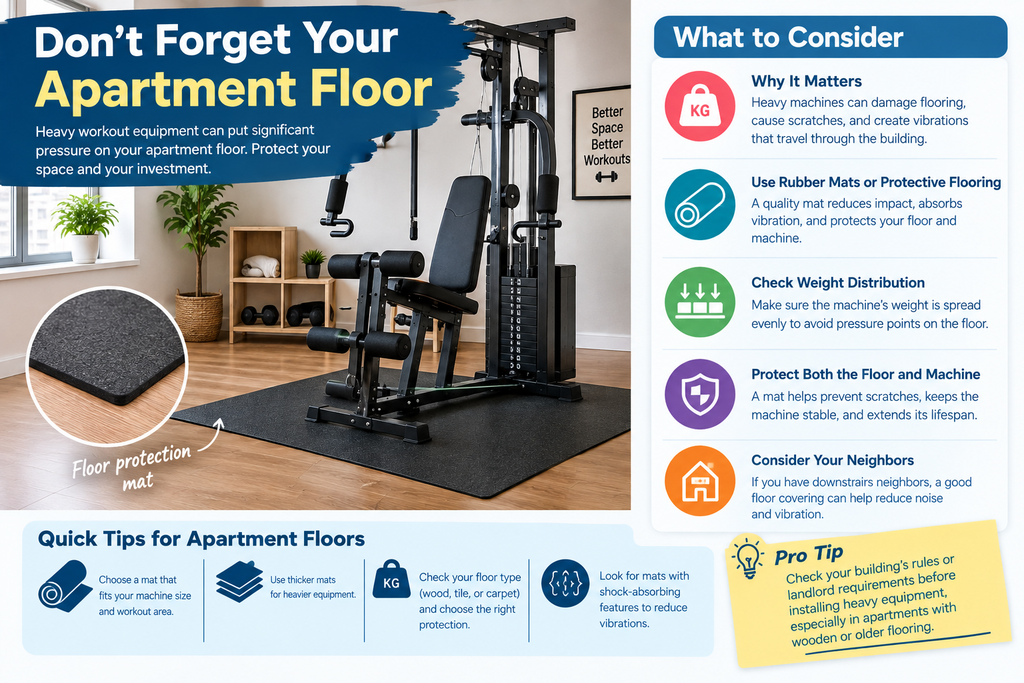
Heavy fitness equipment can put significant loads on the floor.
Before installing an Apartment Workout Machine, consider:
- Rubber flooring
- Exercise mats
- Weight distribution
- Protection against scratches
- Protection from dropped weights
- Vibration reduction
A suitable mat can also help protect the equipment and the surface underneath it.
For particularly heavy equipment, check any relevant building, landlord, or flooring requirements before installation rather than assuming the floor is suitable.
9. Calculate the Total Cost Before You Buy
The advertised machine price is not always the final amount you will spend.
A more realistic calculation is:
Total Cost = Machine + Delivery + Assembly + Accessories + Floor Protection + Future Replacement Parts
Additional expenses may include:
- Weight plates
- Handles
- Bench
- Floor mats
- Assembly
- Replacement cables
- Replacement pads
- Maintenance items
For example, a machine with a lower sticker price may require several additional accessories before you can use it the way you intended.
On the other hand, a higher price does not automatically prove better quality.
Compare the complete setup, not just the headline price.
Resistance Bands vs Suspension Trainers vs Rowers for Small Spaces
10. Check Assembly Requirements
Apartment buyers also need to think about how the equipment will get inside the home.
Before ordering, check:
- Package dimensions
- Doorway access
- Stairway access
- Elevator limitations
- Number of people required for assembly
- Estimated assembly time
- Professional assembly availability
A machine may fit in your workout area but still be difficult to move through a narrow hallway, doorway, staircase, or elevator.
Checking these details before delivery can prevent an avoidable problem.
11. Check Maintenance and Replacement Parts
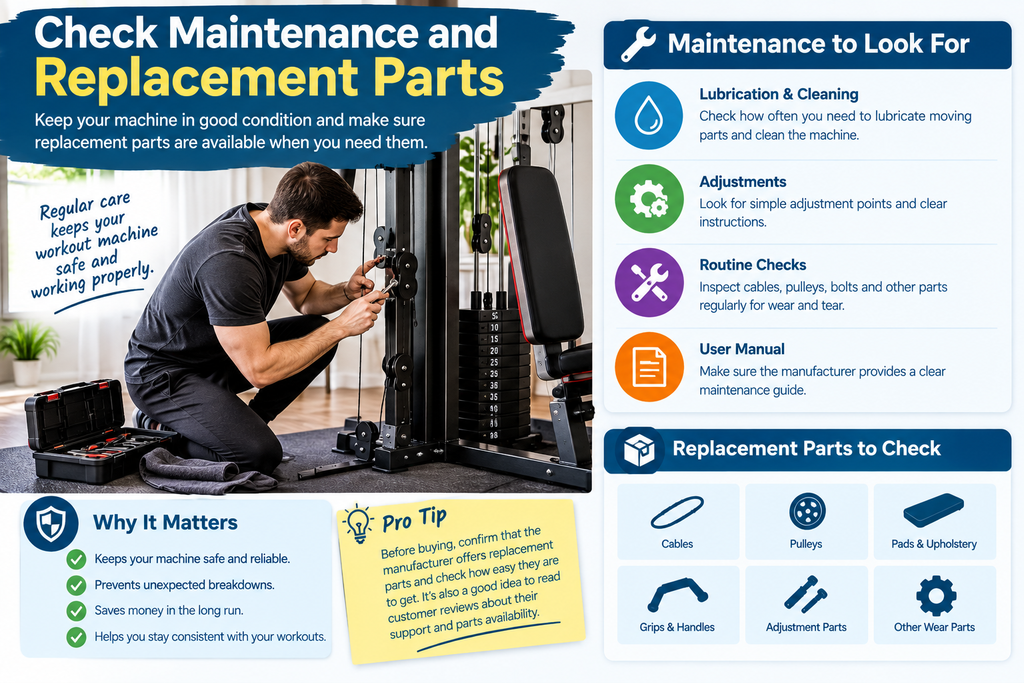
Your purchase does not end when the machine arrives.
Over time, some components may need maintenance or replacement.
Check whether the manufacturer provides replacement parts for:
- Cables
- Pulleys
- Pads
- Grips
- Adjustment components
- Other wear items
This is particularly important if you expect to use the equipment several times a week.
A machine can be difficult to maintain if important replacement parts are unavailable.
12. Read the Warranty Carefully
Do not judge a warranty only by phrases such as “limited lifetime warranty.”
Read the actual terms and determine what is covered.
Check:
- Frame warranty
- Parts warranty
- Cable warranty
- Upholstery warranty
- Labor coverage
- Replacement-part process
- Warranty exclusions
Also check how you would contact the manufacturer if something goes wrong.
A warranty is more useful when you understand exactly which components and services it covers.
How to Build a Daily Walking Routine for Healthy Weight Management
13. Match the Machine to Your Fitness Goals
There is no single Apartment Workout Machine that fits every person’s needs.
If Your Goal Is General Fitness
Prioritize:
- Versatility
- Ease of use
- Compact design
- Basic full-body exercise coverage
If Your Goal Is Strength Training
Pay closer attention to:
- Resistance range
- Maximum loading
- Stability
- Progression options
If Your Goal Is Muscle Building
Consider:
- Useful cable positions
- Appropriate resistance
- Adjustability
- Exercises that allow progressive overload
If You Are a Beginner
Prioritize:
- Straightforward adjustments
- Safety
- Stability
- Easy-to-understand instructions
Your actual workout goals should guide your equipment choices rather than simply choosing the machine with the longest feature list.
14. Common Apartment Workout Machine Buying Mistakes
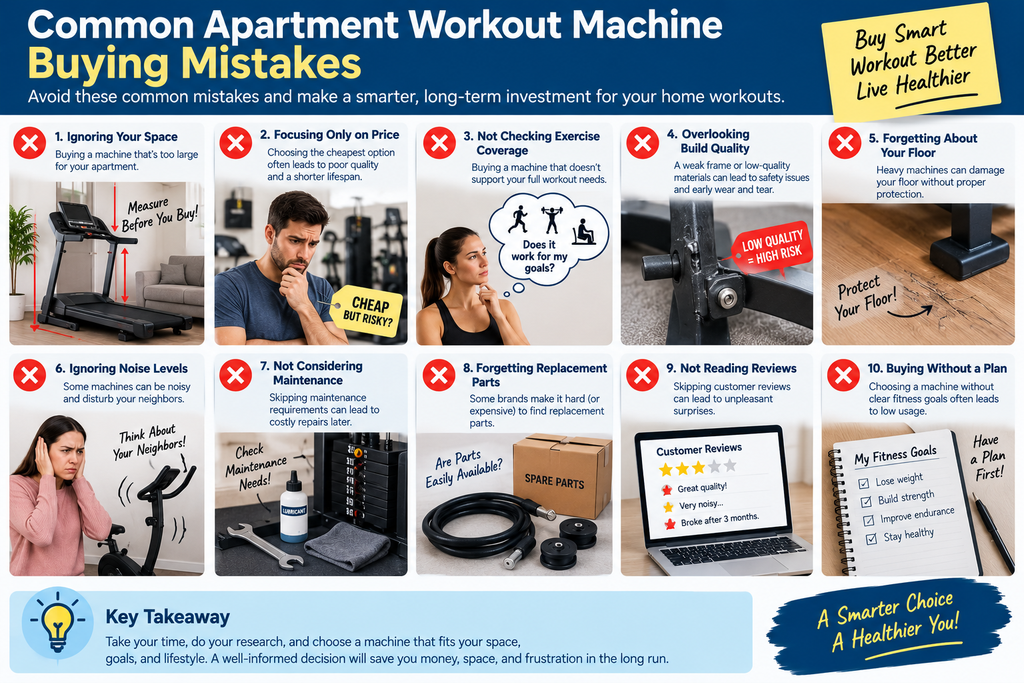
Before purchasing, watch out for these common mistakes.
Mistake 1: Buying Based on Exercise Count
“100 exercises” may sound impressive, but the important question is whether those exercises are useful to you.
Mistake 2: Ignoring Workout Clearance
The equipment may fit physically while leaving too little room to exercise safely.
Mistake 3: Focusing Only on Maximum Resistance
Starting resistance, progression, stability, and exercise suitability matter too.
Mistake 4: Ignoring Noise
Noise and vibration can matter more when you share walls, floors, or ceilings with other residents.
Mistake 5: Forgetting Total Cost
The advertised price may not include accessories, delivery, assembly, floor protection, or future replacement parts.
Mistake 6: Assuming Expensive Means Better
Price alone does not establish quality.
Mistake 7: Ignoring Replacement Parts
Check whether important parts can be replaced before committing to the purchase.
15. Apartment Workout Machine Pre-Purchase Checklist
Before clicking Buy, run through this checklist.
Space
- Does it fit the available floor space?
- Is the ceiling high enough?
- Is there enough clearance for exercise?
- Can it get through the doorway?
Exercise
- Does it support the exercises I actually want?
- Does it cover my major movement patterns?
- Can I change exercises easily?
Resistance
- Is the starting resistance appropriate?
- Is the maximum resistance sufficient?
- Can I increase resistance gradually?
Comfort
- Does it adjust to my height?
- Are the seat and bench positions adjustable?
- Are the handles comfortable?
Apartment Use
- Is it reasonably quiet?
- Is it stable?
- Can I protect the floor?
- Could vibration be an issue?
Ownership
- What is the total cost?
- How difficult is assembly?
- Are replacement parts available?
- What exactly does the warranty cover?
Final Takeaway
The right Apartment Workout Machine is not necessarily the one with the most attachments, the largest exercise count, or the highest price.
Instead, evaluate the things that will affect your everyday use:
Space + Exercise Coverage + Resistance + Progression + Stability + Adjustability + Noise + Safety + Total Cost
Before buying, measure your space, identify the exercises you actually need, check the resistance range and progression options, consider noise and stability, and calculate the complete ownership cost.
A machine that fits your apartment and your training needs can be more practical than one that simply looks impressive on a product page.